The Fresh-Start Fallacy in Creative Work
The fresh-start fallacy in creative work makes a stalled idea look disposable. Change one constraint to reveal a workable next move without erasing its core.
The fresh-start fallacy in creative work often appears beside a half-filled sketchbook: the concept feels tired, so the maker reaches for a blank page. But a stalled idea may not need replacing. Sometimes one changed constraint—a smaller format, a different audience, or a limited set of materials—makes a next move visible while preserving what was worth pursuing.
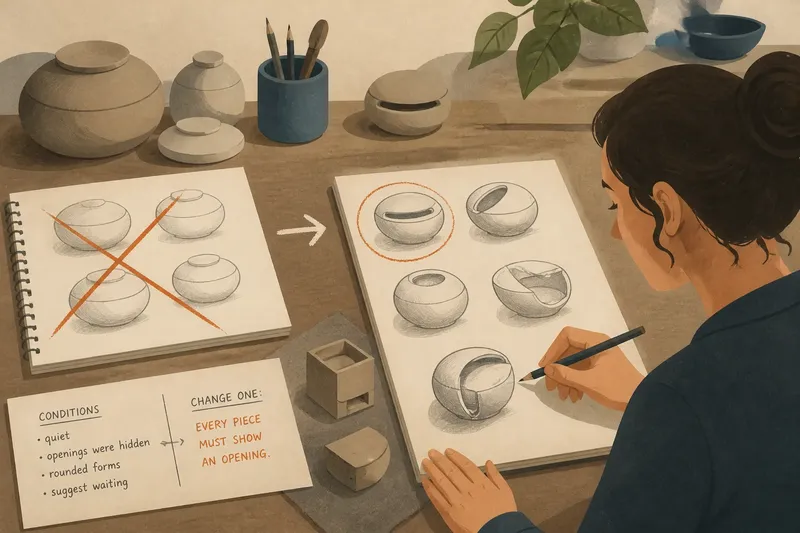
Consider an invented situation: Mara, a ceramic artist, wants to make a small group of objects about the feeling of waiting. She has sketches of covered bowls, closed lids, and smooth surfaces. Each drawing seems to repeat the same visual thought. She is tempted to abandon the subject and begin again. Instead, she changes one constraint: every object must include a visible opening. The shift does not solve the work for her, but it gives her a specific question to answer.
The Stalled Idea
Mara’s project has a clear subject but no developing form. The sketches share a calm, sealed quality. A new sketch might vary the shape, yet the underlying decision remains unchanged: each object withholds its interior. The repetition is not simply a shortage of imagination. It is evidence that one of the project’s conditions has become too narrow.
That distinction matters. If the subject itself has lost its meaning, a new beginning may be honest. But if the subject still holds some charge and the work keeps arriving at the same answer, discarding everything can remove the most useful material along with the frustrating parts. Mara still cares about the tension between being ready and having to wait. What has gone flat is her way of expressing it.
She does not need to pretend the sketches are successful. She can treat them as observations: rounded forms recur; lids conceal; the surface offers little invitation to look closer. Naming those habits gives her something more precise than the vague verdict that the idea has run out.
One Constraint Moves
Mara writes down the conditions she has been carrying, some deliberately and some by habit: the objects should feel quiet, their openings should be hidden, the forms should remain rounded, and the group should suggest waiting rather than action. She chooses one condition to alter and leaves the others alone. Every piece must now show an opening.
This is a narrow change, not a new brief. She keeps the subject, the medium, and the quiet tone. The opening can be small, but it cannot disappear under a lid. That boundary gives her a practical test for the next sketch: where does the opening sit, and what does its visibility make a viewer expect?
A constraint is useful here because it shapes attention. Before, Mara could keep drawing variations that repeated concealment. Now she has to notice edges, angles, and the relationship between an outside and an inside. The new condition does not dictate a final form. It makes a previously ignored part of the form harder to avoid.
Changing one constraint also helps keep the experiment legible. If Mara changed the material, subject, scale, tone, and audience at the same time, she would have trouble telling which alteration opened the work and which merely made it unfamiliar. Holding most conditions steady gives her a clearer comparison, without turning the process into a test that must produce a particular result.
From Opening to Action
Say Mara sketches a bowl with a narrow slot rather than a removable lid. The slot exposes a dark line of interior, but the form still seems sealed. She circles the drawing, not because it is finished, but because the opening changes the viewer’s position: the object now appears to permit a look while withholding a clear view.
That response suggests a next question: should the opening be difficult to see, or difficult to use? Mara draws another version with an offset rim, then a third with a cutaway side. Each remains connected to waiting, but the objects now express different kinds of delay. One offers access that is awkward; another makes the interior visible but unreachable.
The useful result is not a sudden masterpiece. It is a set of distinctions she can work with. The original sketches treated waiting as closure. The new drawings let waiting involve partial access, uncertainty, or an interruption. A single constraint has made the idea more varied without asking Mara to pretend she has found a wholly different subject.
In an actual studio, the same logic can be carried into a small material trial: a paper model, a clay sample, or a quick mock-up in cardboard. The point is to choose a form of making appropriate to the work and the maker’s skills, not to rush into a consequential or hazardous process. If a material or tool raises safety questions, follow its instructions and consult a qualified professional where needed.
What the Shift Preserves
Changing a constraint can be mistaken for lowering standards. Mara is not declaring that any visible opening will do. She is creating a narrower field in which she can make a more informed choice. The sketches still need judgment: does the opening contribute to the subject, or is it merely a novelty? Does it change the object’s character, or only decorate it?
She can answer by comparing each drawing against the project’s enduring concern. An opening that makes the object feel freely available may weaken the sense of waiting she wants. One that creates a glimpse without easy access may deepen it. This comparison lets her reject weak variations without rejecting the entire project.
Just as important, she preserves the evidence in the earlier work. The repeated lids have shown her that concealment is central to the idea, even if it cannot carry the whole group. She does not have to erase or disown those drawings. They can remain a record of the project’s first answer and a reference point for judging what the new answer changes.
A fresh start is sometimes needed, but it should not be the automatic response to repetition. Repetition can signal that the central question has been answered as far as one set of conditions allows. The next move may be to adjust the conditions and see what other answer the same question can support.
When Is a New Start Useful?
How can you tell if an idea is stuck?
Look for a recurring decision, not just a recurring subject. If each draft or sketch reaches the same form despite small variations, note the choice being repeated and ask which condition keeps producing it.
Which constraint should change first?
Choose a condition that is shaping the repeated result, and change only that one for a short period of exploration. Keep the subject and other important intentions steady so you can see what the altered condition makes possible.
What if the new version feels worse?
A less satisfying version can still reveal a useful boundary: perhaps the change moved too far from the project’s core, or exposed a quality you want to keep. You can revise the constraint or restore it and try a different one; the attempt need not become the finished work.
When should you abandon the idea?
Consider setting it aside if the subject no longer matters to you or if repeated shifts keep producing work you do not want to pursue. You can make that decision after a focused exploration, rather than treating one spell of repetition as conclusive evidence.
A Focused Next Move
Mara’s situation offers a modest way to respond to creative resistance. She first names the repeated answer, then identifies a condition that has kept it in place. She changes that condition while protecting the parts of the idea that still feel alive, and she looks for a meaningful difference in the work—not an instant resolution.
For a reader facing a similar pause, the action can be small: write down the recurring choice, list the constraints around it, and select one to revise. If a project keeps producing closed forms, the changed condition might concern access. If every draft sounds formal, it might concern who is speaking to whom. The most useful change is specific to the repetition, not a rule borrowed from someone else’s process.
There is no need to produce an elaborate system for this. A wall covered in color-coded notes, a new notebook, or a full project reset may consume attention without changing the decision the work is repeating. A few honest observations and one deliberate alteration are often enough to make the next session more concrete.
The fresh-start fallacy in creative work is not the belief that beginnings have no value. It is the assumption that a beginning must be clean to be useful. Mara’s new opening only matters because it gives an existing idea another way to speak. When a project still has a pulse, its next form may be waiting inside one condition you have not yet thought to change.