A Five-Minute Looking Walk
A five-minute looking walk turns an ordinary neighborhood route into a source of fresh ideas by using shifts in texture and shape as prompts.
You step out to collect a package, take the dog around the block, or stretch your legs between tasks. A five-minute looking walk can make that familiar route feel less automatic: plan it around changes in texture and shape, not places you mean to reach. The point is not to cover ground. It is to give your attention a small, clear job.
Choose a compact route
Start where you can pause without blocking a doorway or crossing. Pick a short loop, a stretch of sidewalk, or even the view along one side of a courtyard. Keep the route ordinary enough that you do not need to consult a map or hurry toward a destination.
Before leaving, set a timer for five minutes if that helps you avoid turning the exercise into an errand. Choose a walking pace that leaves room to look. You can stay on public paths and skip any stretch that feels uncomfortable; the exercise works with whatever route is convenient.
Give the walk a simple sequence: notice one surface, then one shape, then a change between them. You are not collecting a complete record of the street. You are following a thread through things already in view.
Begin with a surface
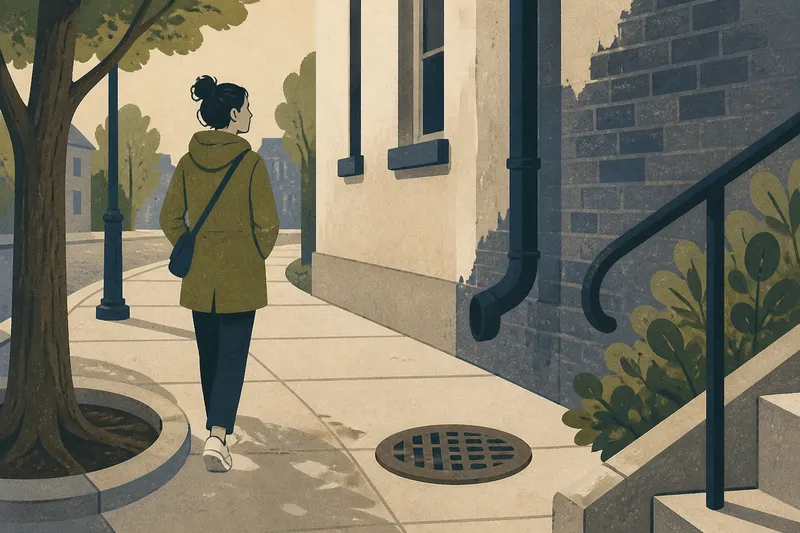
For the first part of the walk, look for texture at roughly eye level or lower. A brick wall may have chipped edges; a metal drain cover may hold a pattern of slots; a tree trunk may be ridged beside smooth pavement. Notice how a surface changes with wear, weather, repairs, or a shift in material.
Try describing what you see without naming its purpose. Instead of “a fence,” you might register “thin bars, a rough post, and a strip of paint worn smooth.” This small adjustment holds attention on the visible qualities rather than moving straight to a familiar label.
Do not touch surfaces or step into a path to inspect them. A glance is enough. If nothing catches your eye, keep moving and let the next section of the route offer another chance.
Follow a change in shape
Once a texture has held your attention, look for a shape that changes nearby. A row of rectangular windows might meet the round outline of a drainpipe. A straight curb could bend around a planted patch. A branch may split into a fork above a hard-edged sign.
Shape here does not mean a perfect geometric figure. Look for edges, openings, bends, clusters, and gaps. The useful prompt is a transition: where does one kind of form give way to another, and what becomes noticeable at that boundary?
Let the route take a gentle turn only if it is easy and safe to do so. You do not need to chase an interesting object down a private drive or cross a busy street. A nearby change in outline is enough to continue the walk.
Let the route vary
To keep the routine from becoming a hunt for the same details, assign a different emphasis to each day you use it. On one walk, attend to rough beside smooth. On another, notice straight beside curved. On a third, look for small shapes repeated across a larger surface. These are prompts, not rules; follow a different detail if it becomes more compelling.
Say you leave an apartment building on a cloudy morning and choose “straight beside curved.” You notice the straight seams in a sidewalk, then a rounded tree well interrupting them, followed by a bent handrail. The expected result is not a conclusion about the block but a brief, observable change in what your eyes keep tracking: edges and turns become easier to pick out.
Across a week, you can alternate these prompts rather than trying to improve on yesterday’s walk. If you miss a day, resume with whatever surface or shape is in front of you. The exercise is meant to fit into an ordinary routine, not create another appointment to keep.
What should you notice?
What if the route feels too familiar?
Keep the route and change the prompt. Looking for a seam, a patch, or a repeated curve can make a known sidewalk newly legible without requiring you to find a new neighborhood.
What if nothing stands out?
Lower the demand for novelty. Notice one plain transition, such as concrete meeting soil or a smooth window beside a textured wall, and continue at an easy pace.
Should you take notes during the walk?
Usually, it is enough to hold one detail in mind until you finish. If you want to remember it, write a few words afterward, such as “rough stone, round opening, dark seam,” rather than stopping repeatedly to document everything.
What is not worth the effort?
There is little benefit in turning the route into a scavenger hunt, forcing every observation into a metaphor, or photographing each surface. Those tasks can pull attention away from the quiet act of seeing what changes beside you.
Close with one detail
At the end of five minutes, pause somewhere you can stand comfortably and choose one detail to carry with you. It might be the way a crack divides a flat surface, or the contrast between a soft outline and a hard edge. You do not need to explain why it matters.
If you want to extend the walk into creative work, write one sentence describing the detail without interpreting it. Later, you might use that sentence as a starting point for a sketch, a question, or a scene. Keep the description close to what you saw; its value lies in preserving a specific observation, not in making it sound profound.
A five-minute looking walk is most useful when its boundary stays modest: a familiar route, a shifting visual prompt, and one detail retained at the end. When the path is busy, the weather is poor, or your attention is needed elsewhere, shorten it or leave it for another time. The neighborhood will still be there, with a different edge waiting to catch your eye.